
Once upon a time, if you entered the office of an investment bank, opened your books, and showed that your business was a money pit with no chance of ever turning a profit, at best, they would have listened to your pitch and then shown you the door. At worst, you would have had a hard time making it past reception in the office building. For a mysterious reason, AI companies have not only been welcomed with open arms but also offered all kinds of support and even lines of credit to carry on incinerating as much cash as possible up to the point of having investment banks competing to bring them to IPO.
Once upon a time, a company seeking to go public had to prove it could survive more than a glossy roadshow. Regulators, auditors, and lawyers would comb through its books, controls, loans, capital, and compliance record, asking whether every number and every promise could withstand daylight. They would probe money-laundering safeguards, customer treatment, litigation, cyber risks, and the possibility that one buried scandal could turn a celebrated listing into a reputational bonfire. The bank would disclose its risks, fix what it could, and persuade investors that its business was sound. Only then could the bell ring without sounding an alarm. Somehow, investment banks are throwing all of this out the window for AI companies, especially the big ones like Anthropic. Is it because the IPO fees and future business they can win “justify” closing both eyes and going ahead, confident that eventual fines in the future will be just a cost of doing business, as has been the case for Wall Street for a while? Is it because banks are so exposed to the risk of these companies going bust that the risk of eventual losses justifies throwing any sound business practice out of the window? Is it because you like telling yourself you are helping the “great AI revolution” and providing a great value-added service to the public? Is it because the government is “sponsoring” AI companies, allowing them leeway that, in a normal world, they would not have?
The Wall Street Journal just disclosed some key metrics from the still-not-public Anthropic IPO S-1 filing, and the whole world is rightfully feeling a sense of dizziness reading the numbers. I would like to emphasize again, as I have done so many times now that I have lost count, both on X and, most recently, yesterday on YouTube, that Anthropic’s S-1 filing IS STILL NOT PUBLIC AND THAT’S A MUST IF THE COMPANY WANTS TO IPO ITS SHARES. Here is my argument: if investor demand were strong and Anthropic’s numbers looked compelling, even if horrible at present, the company, like many others (I don’t want to name names, but you can easily find plenty of recent examples), would have already listed its shares a while ago. However, this is not happening. Why? Either investor demand isn’t that strong at a $2 trillion price tag, everyone who looked at the numbers smiled at them and ended the meeting, or it’s a combination of these two scenarios.
According to the WSJ, Anthropic lost EIGHTY FREAKING BILLION US DOLLARS in the first half of 2026 alone. Yes, EIGHT-ZERO FREAKING BILLION US DOLLARS. Dario Amodei can try to spin the numbers around as much as he pleases, claiming all sorts of ARR and whatever, but AUDITED FIGURES are a whole different story.
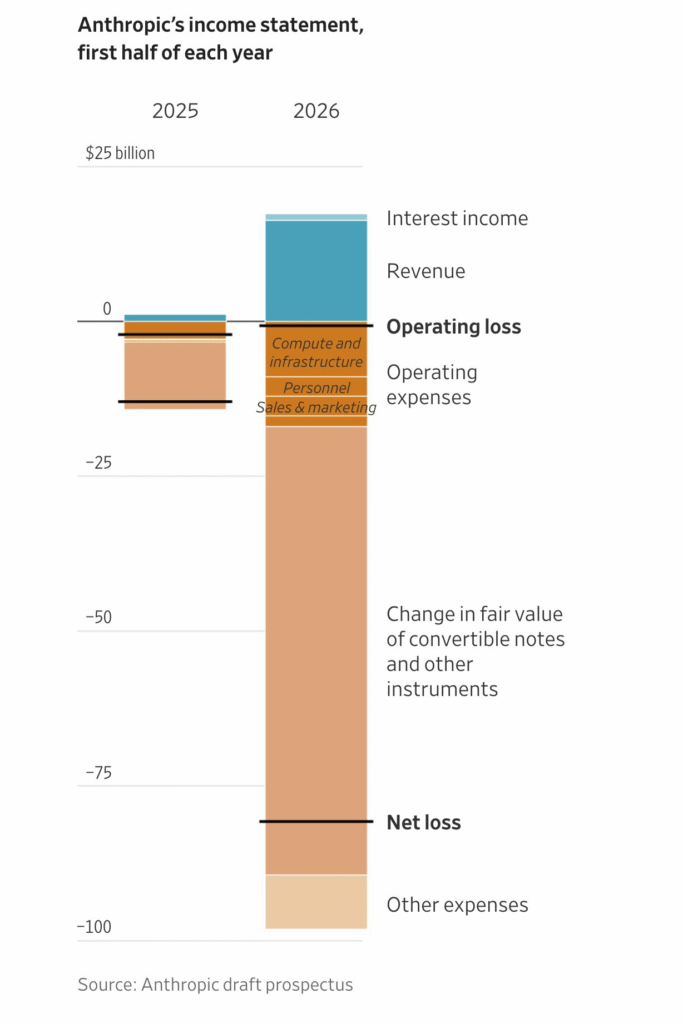
“Change in fair value of convertible notes and other instruments” is the elephant in the room here, because without that, Anthropic’s net loss would have been much smaller in the first half of the year. “Changes in fair value of convertible notes and other instruments” is a non-cash accounting charge (or gain) that appears on the income statement under US GAAP. Convertible notes are debt that can turn into equity (usually preferred stock) in a future financing round or IPO, often with a discount or valuation cap. When these instruments, or their embedded conversion features, are measured at fair value (either as derivative liabilities under ASC 815 or under the fair-value option in ASC 825), the company must remeasure them every reporting period. The value of the conversion right rises when the company’s overall valuation increases. A higher valuation makes the right to convert into equity more valuable to the noteholders, which increases the liability on the company’s books. That increase is recorded as a loss on the income statement. In Anthropic’s case, this effect has been enormous because its private valuation has climbed extremely rapidly, and this is the mirror image of what large investors (Amazon, Google, etc.) record on their side when they mark up the value of their Anthropic notes or preferred stock. Shall we ignore this “non-cash item,” then? Not so fast. Because all that matters for Anthropic is how much cash the company is currently burning and how much cash it needs to fulfil its future purchase commitments of over $600 billion. While we can confidently say that the vast majority of “operating expenses” and “other expenses” (a pretty big item to leave unexplained, something that smells fishy to me) are cash items, we cannot confidently say the same thing with regard to revenues. Why? Because it has already been reported that Anthropic, like its peers, has been accounting for revenues in full even if it has to pay significant rebates to its distributors. What are the chances that “other expenses” are exactly that? In that case, Anthropic’s “real” revenue number for the first half of 2026 would be barely $10 billion, and its operating loss roughly $10 billion, not almost flat as they pretend it is. However, what matters most is that the operating loss would likely be a full cash burn. If you pay attention, you can notice how the accounting significantly changed from 2025 to 2026, likely to boost the revenue figure because, based on what the company shared last year, it surely would not have increased its revenue more than 20-fold so quickly. That only happens when you fudge the numbers, sorry.
Now, please tell me, how the hell can a company with these numbers, an absurd cash burn, a beyond-absurd amount of future liabilities, making bigger losses the more its business grows and with no realistic chance of turning a profit in the future, maybe ever, claim to be worth $2 trillion and raise $100 billion selling shares to the public? Have people all around completely lost their minds, or what?
Until Anthropic opens its books to the public, all its promises remain just that: promises. No glossy roadshow, breathless ARR figure, or massaged accounting can substitute for audited numbers, transparent commitments, and a credible path to sustainable profits. If the business is as revolutionary as its champions insist, surely it can withstand scrutiny. And if it cannot, investors deserve to know before they are asked to bankroll a trillion-dollar fantasy. Banks should stop confusing access with endorsement, and regulators should remember their job is not to bless a story, but to protect the public. The bell should ring only when the facts do.
Dear readers and followers, after many requests over the years for more direct access to me and premium content, I launched a Premium Subscription on Slice Finance. Slice Finance not only lets me share premium content, commentary, and trade ideas for a market-professional audience, but also provides many tools you can use to directly interact with me easily: live chats, group chats, and weekly live streams. I’ve set the subscription fee at a fair, accessible price of 39$ a month with no fixed time commitment. If you’re interested, you can subscribe to my Slice portal by clicking this link: https://bit.ly/JustDario