

On Monday, the 3rd of August, Japan and the US agreed to issue a joint public statement confirming that they coordinated to intervene in the JPY exchange rate. This latest intervention likely cost Japan JPY 8.45 trillion and JPY 5.3 trillion of monetary reserves on Thursday and Friday, respectively, based on moves in the BOJ monetary accounts. While Japan spent almost USD 90 billion of monetary reserves, the US joined the effort, selling between EUR 5 and 10 billion from its accounts on Friday. This is not the first FX intervention this year, but the second. Yes, back in April Japan intervened again in the FX market, albeit without acknowledging it officially, spending an estimated ~ JPY 10 trillion on FX interventions. This means that, so far this year, Japan has spent ~ USD 150 billion in total to prop up the value of the JPY, or ~12.5% of its total foreign currency reserves as of the end of December 2025.
I lost count of how many times I explained why these JPY FX interventions are completely futile and why, without big structural changes that will require brave but painful, draconian monetary and government policies, nothing will break the “Doom Loop” the JPY is trapped in. That will push the currency to devalue past 300 USD/JPY in the long term, as I explained 2 years ago in “A PEEK INTO THE FUTURE: USD/JPY ROAD TO 300”.
If you think Scott Bessent stepped in support of the Japanese government because a weak JPY is a threat to the US financial system, and not just to help an ally in difficulty, your assumption is correct. Over 2 years ago, I explained the mechanics of the “doom loop” that I still see very few people understand in the broad public, mostly because it is counterintuitive: “THE JPY (COUNTERINTUITIVE) DOOM LOOP – THE MORE JPY LOSES VALUE, THE MORE LEVERAGE IS FORCED TO COME OFFLINE, THE MORE THE JPY LOSES VALUE”. Why “counterintuitive”? Because those who have never seen how the JPY carry trades are structured from the inside, but only observed them from the outside, cannot wrap their heads around why a depreciating JPY forces carry trade unwindings. Here is a simple explanation of the phenomenon I shared in a follow-up article in 2024:
First of all, it is important to understand why increasing interest rates will still devalue the JPY. Imagine you buy a brand new car with a loan, then, once driving out from the car dealer, you crash the car. Your asset is now totally worthless, right? But the loan you took remains. This is what happened to Japan in the early 90s.
Now, of course, you need a new car to move around, go to work, go to buy groceries, and so on, so you buy a second one, starting a second loan that the car dealer is more than happy to provide since that money sitting in their account at zero percent would otherwise be totally unproductive.
How can you afford the second loan if you could just afford the first? The BOJ fairy will make a credit card appear where you can expense anything without ever worrying about paying the bill because she has it covered.
How does the fairy pay the bills, though? She will magically print money out of thin air… for more than 30 years. Fascinated by her powers, one day Japan’s prime minister Abe has a “great” idea: let’s ask the fairy to print some extra money to make investments so the overall debt can be repaid faster. Unfortunately, “Abenomics” not only did not work but “greatly” backfired, leaving Japan with a burden of debt, now above 260% debt/GDP, impossible to handle.
All I described above happened while interest rates in Japan were either zero or negative. What do you expect will be the effect of starting to lift interest rates? The cost of debt will increase. How will this be paid? Issuing even more debt. Who will be the buyer of this newly issued debt? The BOJ fairy. How will she pay for it? Printing JPY out of thin air….
Scott Bessent cannot give a dam about a weak JPY hurting the Japanese economy, public finances, and businesses. As a matter of fact, a depreciating JPY is GOOD for the US trade balance. Why? Every year, the US imports from Japan ~$187.9 billion in goods and services ($146.0 billion in goods alone), while the US exports to Japan ~$136.2 billion in goods and services ($82.1 billion in goods alone). Since the US is buying from Japan more than what it sells back, if the JPY loses value compared to the USD, the US can buy the same amount of goods and services spending less USD, hence reducing the trade deficit. Not surprisingly, as you can see in this chart, since the JPY began its structural depreciation (which accelerated once the BOJ began hiking rates), the US trade balance with Japan IMPROVED. At that time, every cat and dog on Wall Street was predicting increasing yields would have strengthened the JPY, while I was explaining the complete opposite would occur. The trade balance is now almost even because Japan, due to the crisis in the Middle East, has been buying a significant amount of crude oil from the US as a result.
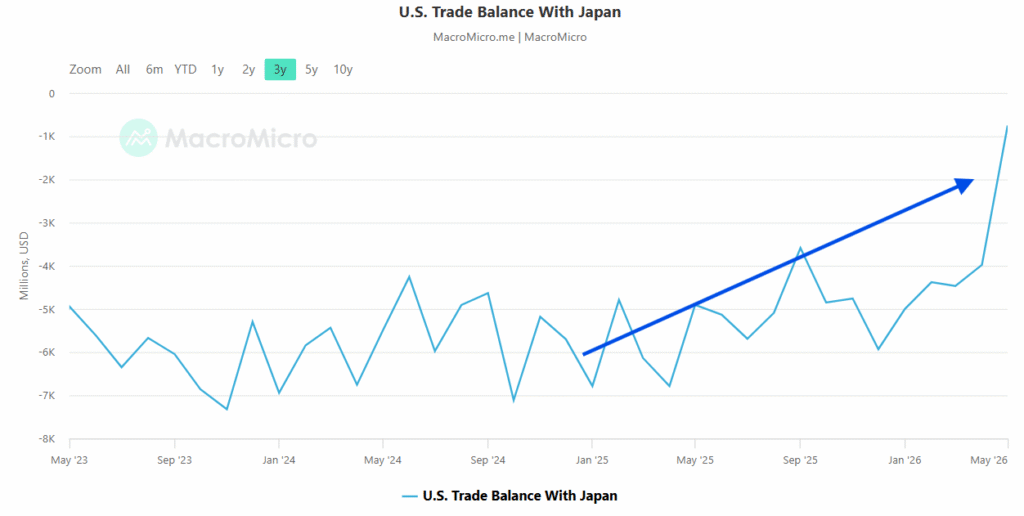
Here is Scott Bessent’s first problem: when Japan buys goods from the US, especially crude oil, it needs USD to pay. Japan has two options: continue printing JPY out of thin air, then sell it for USD in the market, hence increasing the depreciating pressure on the JPY that accelerates the “doom loop”, or sell its USD foreign currency reserves to obtain USD to pay. Japan chose the first option, but once the JPY depreciation comes close to spiraling out of control, it is then forced to intervene in the FX market, ultimately selling US Treasuries. Every time Japan sells US Treasuries, yields will rise, and when yields are elevated (as is the case today), that will bother Scott Bessent and his boss a lot (because rising yields have a huge domestic impact, especially on mortgage rates now above 7% in the US).
Scott Bessent has a second, bigger problem to deal with, though: the unwinding of the JPY carry trade. As I explained earlier, the more the JPY depreciates, the higher the cost to borrow JPY, the less convenient it becomes to borrow in JPY and invest in assets outside Japan. All of this can be summarized in a single chart (USDJPY inverted vs 10Y US yields minus 10Y Japan yields)
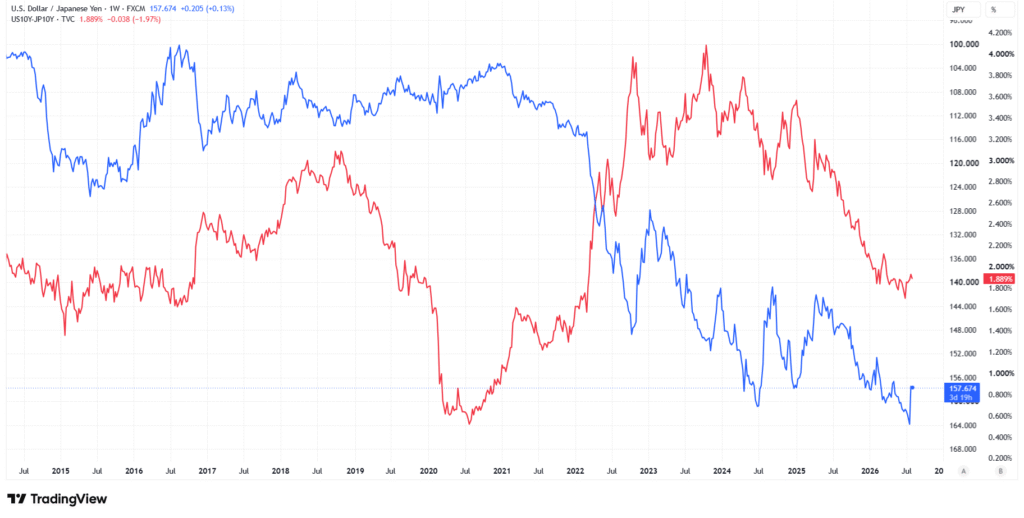
The JPY carry trade allowed ~ USD 2 trillion to be invested in assets outside Japan through the years, most of it in US fixed income (both US Treasuries and credit). The unwinding of the JPY carry trade is not something that can happen in the blink of an eye; it will take many years to unfold. Scott Bessent’s real problem is that even a slowdown of the JPY carry trade will reduce the liquidity bid for US assets, especially for US Treasuries, the more the yield differential narrows. This is happening at the same time the US government is issuing more and more debt to finance its ballooning deficit spending, which can trigger a seizure in the market where THE LAST TRADE IS THE ONE THAT MATTERS BECAUSE IT SETS THE PRICE (AND YIELD) FOR THE REST OF THE DEBT. With less and less demand for US Treasuries from former large buyers like China, and from recently struggling countries in the Middle East that have fewer USD oil revenues to reinvest in US securities, Scott Bessent cannot afford the Japan carry trade bid to evaporate.
Putting it all together: Scott Bessent intervened because the US cannot sustain Japan selling its US Treasuries at the same time as the JPY carry trade demand evaporates, in what can be a disastrous combination for the US that could push long-term yields to levels not seen since the 1970s, when the US survived because its public debt wasn’t as big as it is today.
This is why the title of this article is “Japan just lost control of its foreign currency reserves”. As Scott Bessent made abundantly clear, going forward Japan will have to use the FIMA repo facility if it needs USD to intervene on the JPY. The Federal Reserve’s FIMA repo facility lets foreign central banks borrow U.S. dollars overnight by using their U.S. Treasury securities as collateral, with a single-counterparty daily cap of $60 billion. Not surprisingly, Scott Bessent is already requesting that this daily cap be significantly increased because it will constrain Japan’s room for maneuver in the market otherwise.
Here is the problem, though: this solution can work only if Japan is dealing with a temporary problem, not a structural one, because it will ultimately have to repay the USD it borrowed. As we know, Japan does not have a temporary problem at all, even if both US and Japanese governments continue blaming “speculators” for “disorderly moves” in the JPY. If you simply look at the USDJPY chart, you will quickly notice the only disorderly moves happen when there is an FX intervention. Interventions are very dangerous and risk triggering volatility shocks in global markets, as happened in 2024 when the JPY appreciated too fast and too much, triggering a 15% daily crash in Japanese stocks and coming close to triggering a big crash in Europe and the US.
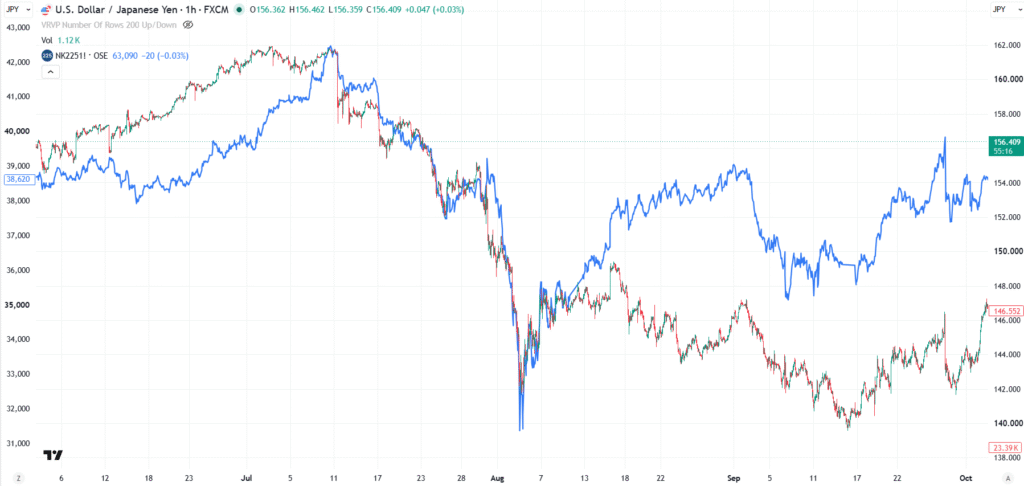
Japan’s interventions may buy time in the short term, but they don’t fix the structural imbalance at the heart of the JPY “doom loop”: rising debt service, persistent monetary expansion, and a carry-trade dynamic that forces deleveraging as the currency weakens. With reserves increasingly constrained and the FIMA repo facility only a temporary bridge, not a solution, Tokyo’s ability to defend the JPY is becoming contingent on U.S. tolerance for higher Treasury yields and tighter global liquidity. Unless Japan is willing to pursue painful, credibility-restoring fiscal and monetary reforms, interventions will remain episodic volatility shocks, while the long-term path of least resistance for USD/JPY is still much, much higher.
Dear readers and followers, after many requests over the years for more direct access to me and premium content, I launched a Premium Subscription on Slice Finance. Slice Finance not only lets me share premium content, commentary, and trade ideas for a market-professional audience, but also provides many tools you can use to directly interact with me easily: live chats, group chats, and weekly live streams. I’ve set the subscription fee at a fair, accessible price of 39$ a month with no fixed time commitment. If you’re interested, you can subscribe to my Slice portal by clicking this link: https://bit.ly/JustDario