

In the current circumstances, you might expect the worsening crude oil crisis to be at the top of every trader’s mind. However, based on all my conversations so far, confidence is so high in governments’ capabilities to avoid shortages of crude oil and distillates that the risk is, at best, being considered a secondary one. While the government can remain in full control of crude oil for a while in the absence of a significant escalation that can wake traders up, like the resumption of active targeting of oil infrastructure in the region or, why not, Iran pulling the trigger on a ground invasion of Kuwait (fyi: when Iraq invaded Kuwait, the oil price quickly doubled), the same cannot be said with regard to the price of distillates, especially middle distillates. I described this whole dynamic in my latest article “WELCOME TO THE NEW ERA OF STATE-CONTROLLED CRUDE OIL PRICES” that you can read on my Slice Finance portal for free, taking advantage of the 7-day free trial period promotion until this Friday.
What everyone is caring about on Wall Street is AI, in particular whether the AI bubble has already popped, is in the process of popping, or still has the energy to run back to new all-time highs. From a fundamental perspective, there is no doubt that the AI bubble is destined to pop spectacularly, bringing back to earth the overbloated valuations of hyperscalers. Valuations that already suffered a significant repricing in the weakest part of the complex, like the neocloud companies. On this front, it should not come as a surprise that Nvidia is being so active in supporting them, not only commercially guaranteeing access to its GPUs even if they cannot afford to pay for them, using leasing agreements (while Nvidia fully booked the sales of those revenues up front), but also buying a direct stake in their operations, so fundamental to continue feeding the great circular financing scheme which greatly benefitted Nvidia for several years and is now sputtering. First, Nvidia built a large stake in Coreweave, which, without Nvidia’s backstop, might not have even been able to successfully IPO; now they are doing the same with Nebius (”Nvidia discloses 9.3% stake in neocloud computing firm Nebius”). A very timely show of support since Nebius, differently from other companies running similar operations, just managed to secure a new line of credit to continue building its datacenters (6-K filing).
Because the whole AI narrative was built upon the ridiculous assumption that private investors would have been able to finance the trillions of capex needed all the way until 2030 when, hopefully by then, the likes of OpenAI and Anthropic would have been able to generate a real profit (not a fake one based on the completely twisted accounting metrics being fed to mainstream media), the whole sector is facing more and more trouble for a very simple problem that could have been easily spotted from the very beginning: private investors did not even have enough money to support the whole plan to begin with.
Different from 18 months ago when I wrote “THE REAL ERA OF AI BEGINS, THE ONE OF THE AI CHARLATANS ENDS”, today investors can no longer ignore the threat of Chinese open-source models that are delivering the same performance as frontier models for a fraction of the cost and using a fraction of the resources. While 18 months ago DeepSeek’s breakthrough was quickly ignored, today investors aren’t ignoring this threat anymore (”Chinese AI model takes US tech industry by surprise with abilities rivaling Claude and ChatGPT”) because, after many years and over a trillion dollars of capital already spent, no company that has heavily bet on AI can show any Return On Investment whatsoever. All they can show, something that I predicted as well one year ago in “HOW BIG TECH SPENDING SPREE MORE AND MORE RESEMBLES 2000s TELECOMS EPIC FAIL”, is their Free Cash Flow crushing through the floor.
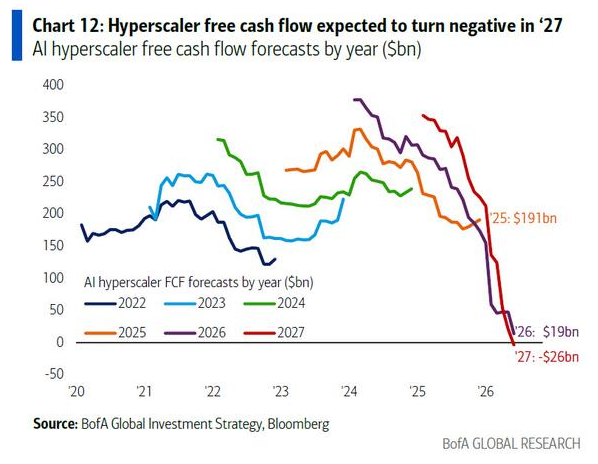
As I warned, all hyperscalers were using the resources from their healthy businesses to subsidize AI and attract funding from lenders that felt assured by the existence of that high-quality collateral. But neither collateral nor money is infinite, as many wrongly assumed. They all know very well that the moment anyone from the group is forced to announce a cut in their capex plans, it will be game over for everyone. That’s the single missing piece of information that is helping investors keep their hopes high, but that moment is only a matter of when it will occur, not if. META remains my first candidate to announce a capex cut and a rethinking of its whole efforts, an expectation reinforced by its recent pivot from being an acquirer of compute to being a seller. A move that will surely impact neocloud companies META booked future computing power with, like CoreWeave and Nebius. I believe it’s only a matter of time here as well until META announces the cancellation of its partnership with these neoclouds.
Quoting the great Ed Zitron, “those that will be damaged the most will be the ones closest to OpenAI”, a sentence I totally agree with. While Anthropic can still rely on a superior product that attracts paying customers who are still not confident shifting to Chinese open-source models, the same cannot be said for OpenAI, which, as a result, has been cutting its prices aggressively and has suffered many big customer cancellations after barely seeing any benefit to their operations after integrating OpenAI models. The companies that are the closest to OpenAI are Microsoft, Nvidia, Oracle, and SoftBank. While Microsoft has already been quietly repositioning itself away from OpenAI in an effort to contain the future write-down it will surely be forced to take, and Nvidia can still rely on demand mostly coming from Anthropic, Oracle and SoftBank are objectively in the worst position. Oracle and SoftBank literally bet everything on the success of OpenAI and are so deeply invested in it that they don’t even have room to pivot away anymore, differently from others. According to S&P, SoftBank’s rating is already junk (and nobody can argue that), while Oracle is one step away from junk (”Why Oracle’s recent credit downgrade could be a warning sign for stocks”). Here is what investors are so far dangerously ignoring about Oracle: the moment its credit rating becomes junk officially, many of those insurance and pension funds that bought its debt, especially long-duration bonds, will have to dump them in the open market, with very thin liquidity to absorb the shock. Not surprisingly, the CDS spreads of Oracle continue to climb.
Let’s not forget one more important thing: OpenAI is also the company that placed an insane amount of orders for memory with Micron, Samsung, and SK Hynix. What do you expect is going to happen when it becomes undeniable that OpenAI will not be able to pay for the now over-trillion-dollar commitments it has with Oracle, Microsoft, and the memory companies?
The AI narrative won Wall Street not because the economics made sense, but because it offered a story strong enough to justify unlimited capex, unlimited leverage, and “profits” that only exist in presentation decks. That story survives as long as markets can pretend the funding stack is stable and the growth curve is inevitable.
The official burst won’t be a slow realization that ROI is weak; everyone already suspects that. It will be a clear funding-and-guidance discontinuity that forces investors to reprice the whole complex at once.
The most credible triggers are:
- The first hyperscaler to publicly cut AI capex guidance (or to signal that incremental spend is being capped because utilization, margins, or power constraints don’t justify it). Once one admits “the curve is flattening,” the rest will be assumed to follow.
- A visible credit event in the AI financing chain: a neocloud refinancing that fails, a large GPU lessor raising rates sharply, a lender pulling commitments, or a meaningful impairment/write-down on AI datacenter assets. The sector is built on rolling over debt; if refinancing windows shut, the math breaks immediately.
- A major customer cohort churns or compresses pricing, not “one big logo leaving,” but evidence that enterprise usage is price-sensitive and substitutable (especially as open-source models keep improving). If revenue per token falls faster than costs per token, the illusion of operating leverage disappears.
- A forced accounting moment: capex capitalization assumptions, useful-life extensions, “adjusted” metrics, or vendor-financed GPU leases getting reclassified or scrutinized. When the market can’t hide losses behind accounting optics, multiples reset.
- OpenAI-adjacent stress: delayed/renegotiated payments, scaled-back commitments, or public restructuring of the biggest contracts (compute, memory, long-term capacity). That would instantly hit the companies most concentrated to the OpenAI ecosystem.
In other words, the trigger is not technological; it’s financial. The bubble bursts the day the market gets hard proof that the AI capex flywheel cannot keep spinning on private financing and optimistic guidance. When that happens, valuations won’t “normalize”; they will gap down, because the entire thesis was priced as certainty, not as a risk.
JUSTDARIO Premium is now live on Slice Finance
Dear readers and followers, after many requests over the years for more direct access to me and premium content, I accepted the invitation to join as a mentor and launched a Premium Subscription on Slice Finance this Sunday. Slice Finance not only lets me share premium content, commentary, and trade ideas for a market-professional audience, but also provides many tools you can use to directly interact with me easily: live chats, group chats, and weekly live streams. I’ve set the subscription fee at a fair, accessible price with no fixed time commitment. If you’re interested, you can subscribe to my premium content and claim a 7-day free trial period till Friday by clicking this link: https://bit.ly/JustDario