

This week started with a “Bang!”, but I am not referring to the sound of bomb or rocket strikes somewhere in the Middle East, but to President Trump’s post that jolted global markets about 2 hours before US cash trading began on Monday.
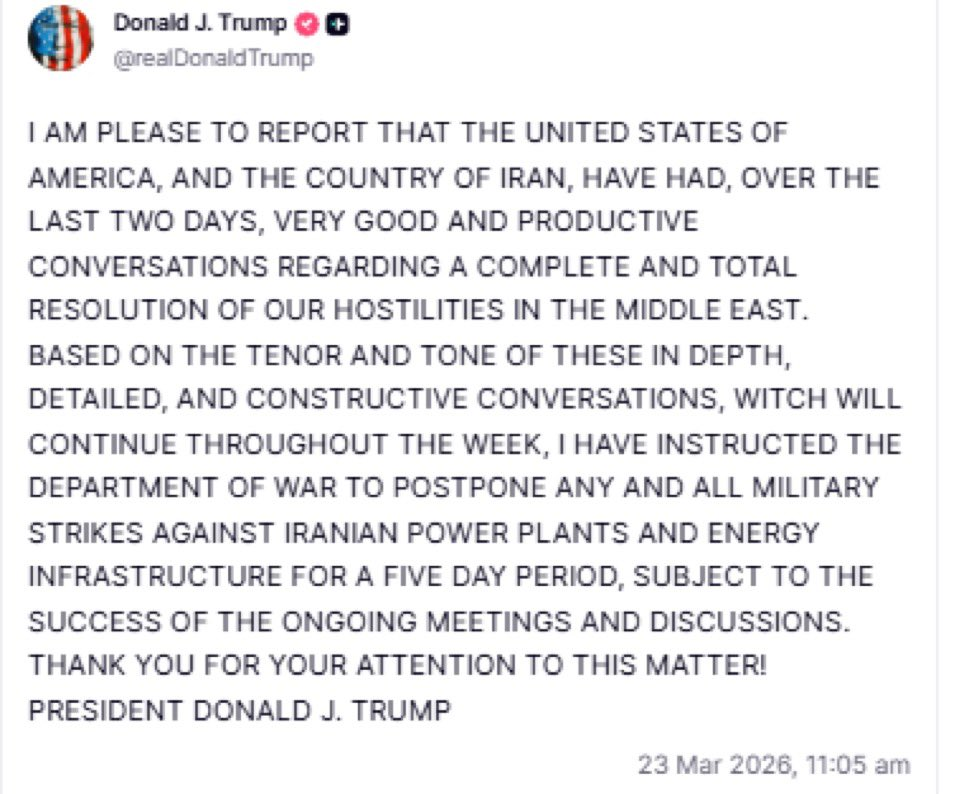
There is plenty of commentary out there on the matter already, some good, some bad, some utterly nonsense. I shared my view on the matter right away on X. It didn’t take long for it to be confirmed, and, as I am writing this article several hours later, reports of US attacks on Iran’s energy infrastructure are already circulating on social media. I am sure there will be official confirmation soon.
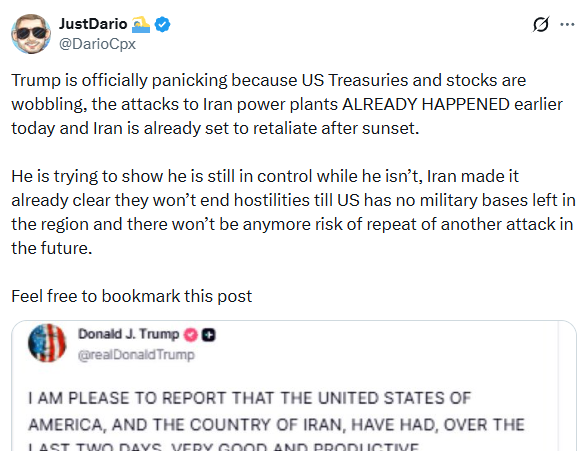
As everyone knows, I am a die-hard gold and silver bug. However, that does not mean I have to suffer from tunnel vision and ignore everything else happening in the world, especially when I identify an opportunity to buy even more gold and silver. At the moment, the opportunity isn’t big; it’s huge, albeit not straightforward.
Let’s take a close look at the immediate impact of Trump’s Monday post:
- Oil flash crashed
- Gold and silver spiked
- Government bond yields came down (meaning govies were bought by investors)
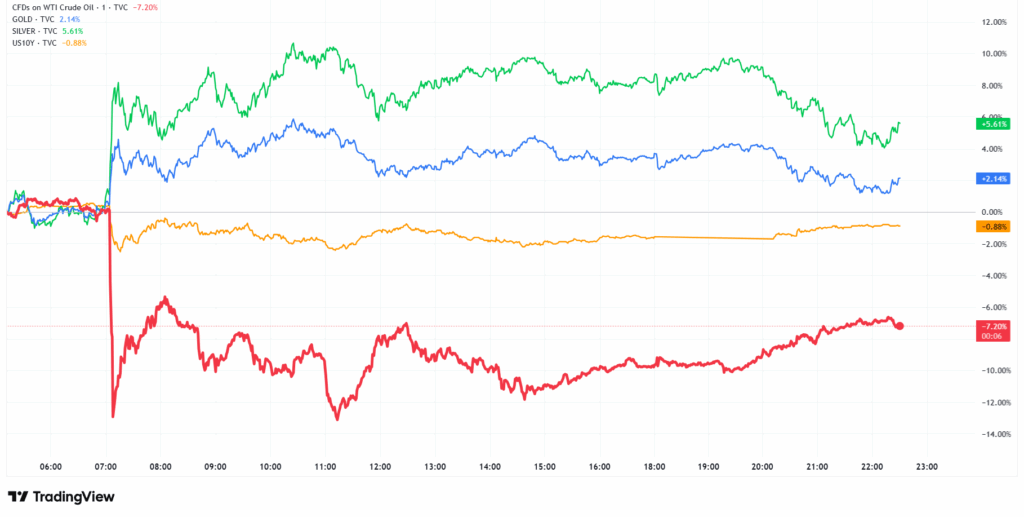
In theory, what happened wasn’t meant to happen. What I just described is counterintuitive since investors rushed to purchase so-called “safe-haven” assets at the moment there was a perception of de-escalation of the ongoing conflict in the Middle East. I already explained why gold, silver, and government bonds have been moving against any rational logic in the past 3 weeks in my latest podcast, “GOLD AND SILVER ARE FACING THEIR WORST ENEMY: A LIQUIDITY CRISIS,” so there is no need today to repeat myself on the matter. The topic I am very eager to discuss today is when gold and silver are expected to bottom, a question I have received so many times in the past few days.
Intuitively, if gold and silver are moving in the opposite direction from oil prices, we should expect a negative correlation coefficient between the two precious metals and oil. As you can see in the chart, the correlation coefficient calculated on a weekly basis became negative shortly after the war started (and we know why), but in the last trading session, it already marked a neutral reading.
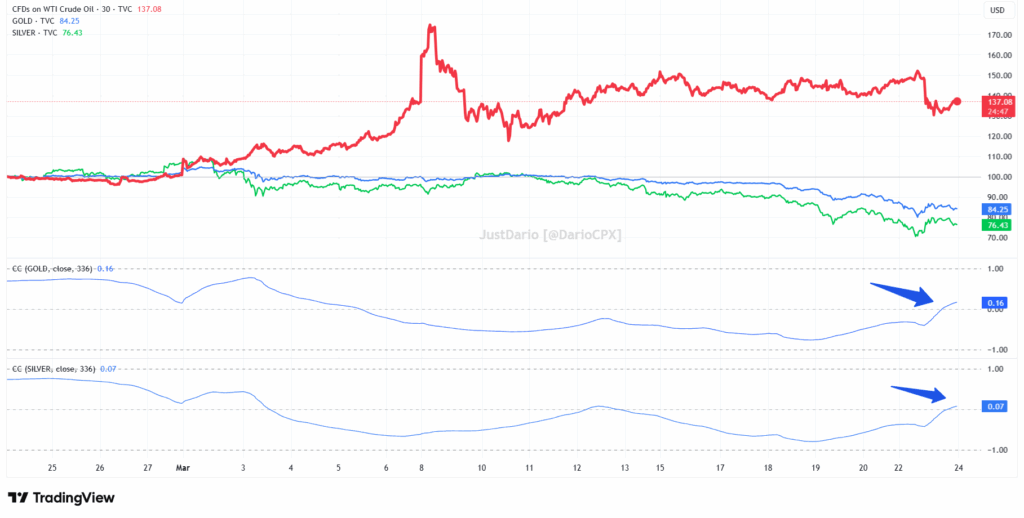
Be careful not to be misled by math here; this coefficient is calculated using the observations over the past week. As a consequence, it is an indicator of trend, not of a strict mathematical relationship in the short term. What the trend of this coefficient is signaling to us is that gold and silver buyers are now starting to compensate sellers more and more. Where are the buyers located? Of course, in Asia:
- BullionStar reported queues to buy physical gold and silver in its Singapore shops already on the 20th of March
- On the same day, reports from China about strong retail demand to buy gold started to filter into social media
- Even Bloomberg, for the first time, acknowledged the record physical silver demand from China, signaling how this trend isn’t expected to slow anytime soon due to the strong demand for EVs, solar panels, and high-performing electronic goods (“China Pulls Silver From Global Markets to Meet Surging Demand“)
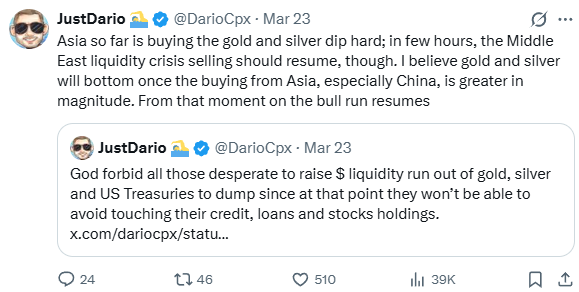
Here is what I warned about on X on Monday after observing the trend in gold and silver prices at 9:30 am Hong Kong time (when Shanghai daily session begins) before the flow from the Middle East comes online: “Asia so far is buying the gold and silver dip hard; in a few hours, the Middle East liquidity crisis selling should resume, though. I believe gold and silver will bottom once the buying from Asia, especially China, is greater in magnitude. From that moment on, the bull run resumes.“
Not surprisingly, the bounce in gold and silver prices faded when morning flow from the Middle East started to hit the tape. Why? Because not only is the situation in the region bad, beyond what is still transpiring in the western mainstream media, but it is even worsening. It is estimated that the current oil supply shortage caused by the war in the region is already 10 million barrels a day and is expected to rise soon to 12 million barrels a day. In dollar terms, this means that there are roughly USD ~1 billion of daily cash inflows into the local financial system missing. At the same time, the capital flight from the region continues, caused by both expats and financial institutions bringing their financial assets abroad for safety. Those who own hard assets in the region, such as real estate, are already hedging the risk of GCC currencies depegging, especially AED, because of the heavy concentration of this type of investment in Dubai, increasing the need for local financial institutions and central banks to liquidate assets for USD to compensate for USD outflows and defend hard currency pegs, as I explained last Friday. Additional selling is caused by local sovereign wealth funds already raising their cash holdings ahead of the rebuilding effort that will start once the war ends.
Why is keeping an eye on the oil price important to gauge when gold and silver are going to bottom? As a matter of fact, for the past 11 trading days, the oil price went nowhere, only briefly crossing USD 100 on the WTI and USD 110 on the Brent, thanks to the, so far, successful government-sponsored price manipulation of the oil futures market. At the same time, the drawdown in gold, silver, and global government bonds continued, confirming how the flow is linked to a liquidity crisis with its epicenter in the Middle East financial system. With oil shortages already reported in Australia, Singapore, Vietnam, and the European country of Slovenia, oil prices will be forced to rise as these shortages spread to other countries. I know what I am saying sounds so similar to what happened in 2020, when it took over a month for US and European stock markets to realize the gravity of the virus coming from Asia. Don’t be surprised if a similar “sudden” shock happens again this time, especially when traders are still convinced, and positioned accordingly, for the war to come to a sudden end and the situation to quickly go back to normal in the blink of an eye, as if nothing had happened. I already warned about this, too, in “THE INCOMING SHOCK IS GOING TO BE WORSE THAN THE COVID ONE” and it will be intellectually dishonest for me to stop doing so.
All in all, the oil price in the current situation is the perfect barometer of stress in the financial system, even beyond the Middle East. Demand destruction will have a significant impact on companies’ revenues across the globe since everything is pretty much tied directly or indirectly to the oil price. Because of missing revenues and higher uncertainty, companies and investors will surely increase their cash buffers, adding pressure to those that are the easiest to liquidate with limited impact on the spot price like gold, silver, and government bonds. However, investors cannot liquidate all their safest assets and remain exposed to stocks set to lose a significant amount of value due to missing revenues as a consequence of the disruptions to the global economy spreading from the Middle East. Stocks are already suffering, but not as much compared to gold, silver, and government bonds yet. Expect this to change suddenly, similar to what happened ahead of any severe financial crisis the world has experienced over the past decades. This is when, contrary to the idiotic narratives spread right now, central banks will step in, cutting rates and resuming hardcore quantitative easing.
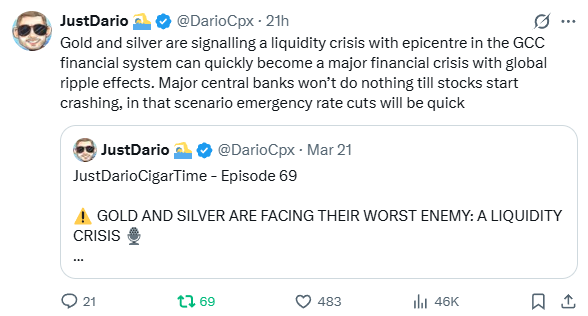
When the oil price finds its new long-term supply and demand equilibrium, financial institutions in the Middle East will be forced to start liquidating their very large holdings of stocks and corporate bonds, and central banks are back in full printing mode, it will be the best time to resume accumulating gold and silver that will greatly benefit from another huge wave of fiat currency debasement. Let’s not forget that a financial crisis even larger than the subprime one in 2008 is already unfolding, another reminder of that hit the tape yesterday with another private credit fund limiting the amount of withdrawal requests from investors (“Apollo private credit fund limits investor withdrawals after requests surge“). This means even more money printing is to be expected in the future, beyond what’s already needed to compensate for the damages to the global economy caused by the war in the Middle East. Timing the market is impossible; today, I provided a framework I will personally use, and I hope it will be helpful for all of you. Be careful of misleading narratives and reckless market manipulation with an impact on short-term price action. Trying to trade such a market is very dangerous, especially with leverage, but wise long-term positioning will surely be rewarded.