

Tuesday, the 10th of March 2026, will likely enter the history books as the date when state-sponsored market manipulation became official. Yesterday, around 11:20 AM EST, US Energy Secretary Chris Wright announced with a post on X how the US Navy successfully escorted an oil tanker through the Strait of Hormuz to ensure oil remained flowing to global markets.
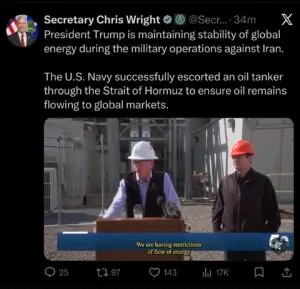
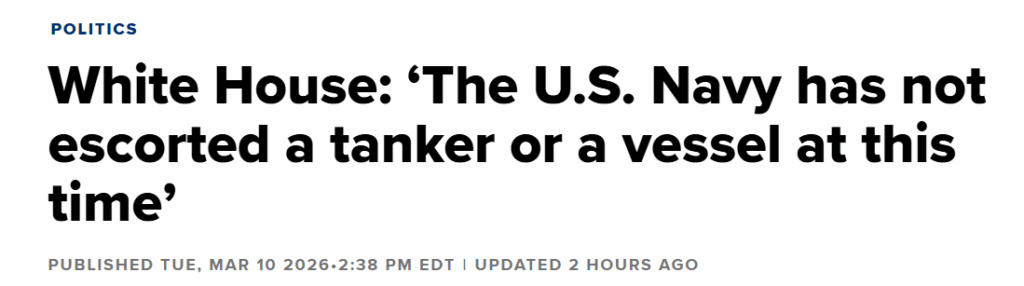
That claim was, of course, blatant fake news, and not only was the post on X quickly deleted, but the White House promptly issued a statement to officially deny the false claim of Secretary Wright.
Shall we archive all that just happened as a “mistake” and move on? Well, I don’t think so. As you can see in the chart here, the sharp move lower in the price of US crude oil started hours ahead of Wright’s post. Then, at the exact time of the post, the market came to a halt, then rallied before starting to crash sharply afterwards.
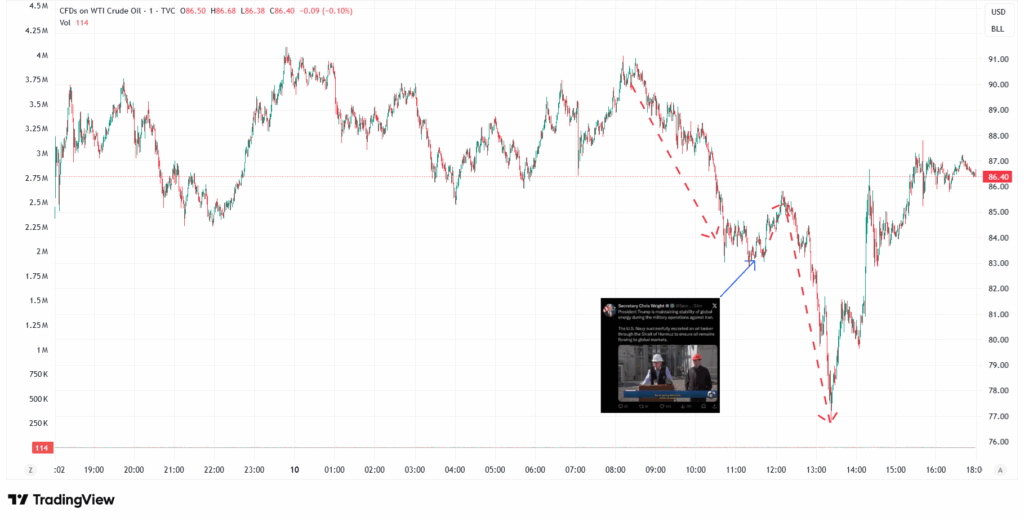
In other words, it’s hard not to believe insiders were in a position to front-run that announcement, considering how the price rallied in the minutes following the post as a sign short positions were being closed for a profit. However, what insiders clearly did not expect was for the market to believe that claim. As a consequence, as soon as trading algorithms started to pick up mainstream media “breaking news” spreading the false claim, they started dumping US crude oil futures aggressively. Objectively speaking, the claim in Wright’s post was so blatantly fake to anyone with a bare minimum knowledge of the current situation in the Middle East, but news agencies and mainstream media did not bother to apply any filter and rushed to publish the fake news, nevertheless.
If you think this was an isolated event, I am afraid to bring you an uncomfortable truth: these types of things do happen every day, multiple times a day, and in multiple corners of financial markets. What has been happening in the past 48 hours in the oil market made this completely undeniable:
- Monday ~12:30 AM EST: “G7 to discuss joint release of emergency oil reserves, French source says“
- Monday ~3 PM EST: “Trump says Iran war will be over very soon.”
- Monday ~6 PM EST after US markets close: “Broad agreement in G7 not to release oil reserves just yet, says G7 official.”
- Tuesday ~11:30 AM EST: “US Navy has escorted an oil tanker through Strait of Hormuz, US energy secretary says“
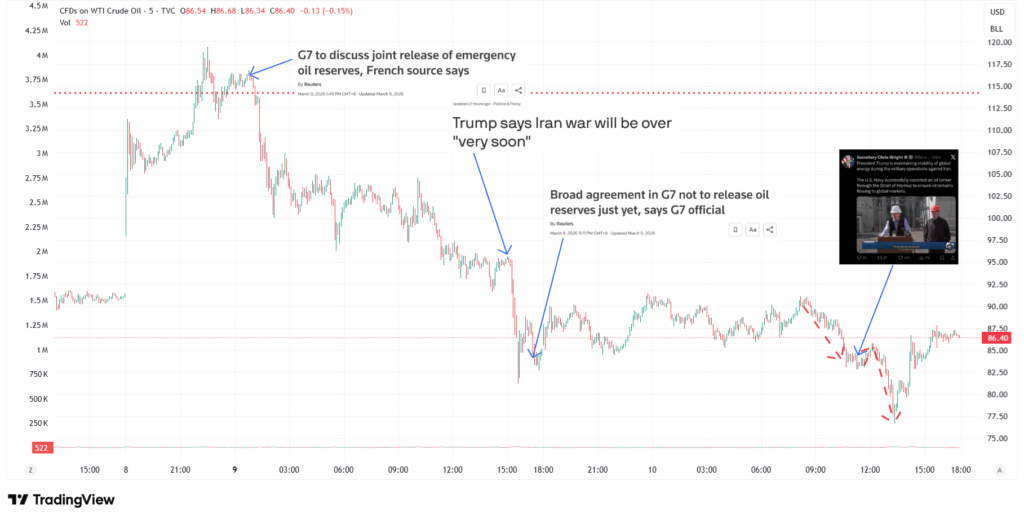
Are the US and its allies coordinating just to manage the narrative with the intent of calming nervous traders, or is there more behind these events, perhaps even an active participation of the governments in the crude oil futures markets to significantly move the oil price lower, strengthening the impression of a market endorsement of their claims? Unfortunately, this is difficult to prove, but the suspicion is strong considering many similar precedents like the Biden administration actively using the release of SPR to force the price of crude oil lower: “Biden’s use of oil reserves overshadows past presidents.” Hilariously, this was a move that Trump himself openly criticized because it would have put the US economy in a very weak spot in case of war, especially in the Middle East.
I have been talking about active price manipulation in financial markets so many times and for so many years that I lost count of them. What’s important to address today is how to read, interpret, and eventually participate in financial markets that are so deeply disconnected from reality. In the case of commodities, as I discussed many times lately when talking about silver, artificially low prices compared to the equilibrium between demand and supply always end up causing a fast depletion of reserves, ultimately causing shortages and moving the price-setting mechanism from publicly regulated markets into the black market. As a consequence, this blatant oil price manipulation will not be able to be effective for too long. Hey Dario! Don’t we live in the era of infinite money? Wouldn’t the US just be able to print all the money it needs to keep shorting crude oil futures if the conflict with Iran carries on for months or even years, keeping the price at the preset level they wish?
Sure, hypothetically, the US administration can post an unlimited amount of margin and does not have any problem taking very large deliveries of oil. However, will oil producers be willing to continue selling oil through the official channels at an artificially low price, especially when the money printing required to keep the oil price suppressed will cause inflation that increases their operating costs, ultimately squeezing their profit margins? The answer here is pretty straightforward. What if the US administration decides to let the crude oil price trade more freely on the market, still prints a ton of money to buy it outright, and resells it within its borders at a capped price much lower than where it should be, in coherence with the wholesale market? In this case, even if the oil price and all those goods and services influenced by it might face artificially low inflation, monetary inflation will flare up significantly and flood different parts of the economic and financial system, ultimately increasing the overall level of inflation and fiat currency purchasing power destruction. Let me be clear, these are extreme examples to help visualize how profoundly wrong price manipulation is for the economic, financial, and social systems, no matter the shape or form.
For investors navigating these distorted markets, the strategy is surprisingly straightforward: recognize that artificial price suppression creates asymmetric risk-reward opportunities. When governments manipulate commodity prices below their natural equilibrium, they create a coiled spring effect. The key is to position yourself on the side of physical reality, not paper promises.
In practical terms, this means accumulating physical exposure to strategically suppressed assets during periods of maximum intervention. For crude oil specifically, consider vehicles that track physical barrels rather than financial derivatives, as futures markets are most susceptible to manipulation. More importantly, extend your time horizon beyond the government’s ability to maintain the intervention. No administration has infinite resources to fight fundamental supply-demand imbalances, especially when doing so requires increasingly visible money printing that undermines their broader economic objectives.
The most powerful insight here is that official market manipulation is actually a gift to patient investors: it telegraphs exactly where the distortion exists and guarantees a violent snapback when the intervention inevitably fails. The only requirements are sufficient capital reserves to weather the manipulation period and the conviction to hold positions while consensus reality diverges from physical reality. When the gap closes, and it always does, the returns can be extraordinary.
SYNNAX PROMO
Get exclusive intelligence on stocks you can’t find anywhere else – insights that could give you a serious edge. Claim your free Synnax trial month now:https://synnax.app/PROMO/JUSTDARIO